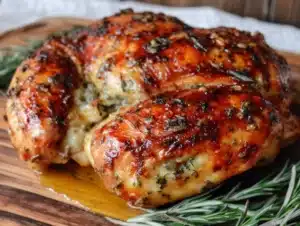
I was standing in the frozen foods aisle at Aldi last November, staring at a twenty-pound bird I had absolutely no business buying, when the smell hit me. It wasn’t turkey—it was rosemary. The weird thing is, nobody near me was cooking. Somebody must have walked past with a candle or something, but in that moment, I wasn’t in the grocery store anymore. I was nine years old, standing in my Aunt Terry’s cramped kitchen in Pittsburgh, watching her shove fistfuls of herb butter under a turkey’s skin like she was paying off a debt. She had this way of talking to the bird while she worked. “You’re gonna be beautiful,” she’d say. “Just you wait.” She passed away five years ago, and I haven’t had her turkey since. Honestly, I think I was scared to try. But standing there holding that frozen bird, I figured it was time. I just didn’t know then that I’d end up spatchcocking it—and that it would change everything.
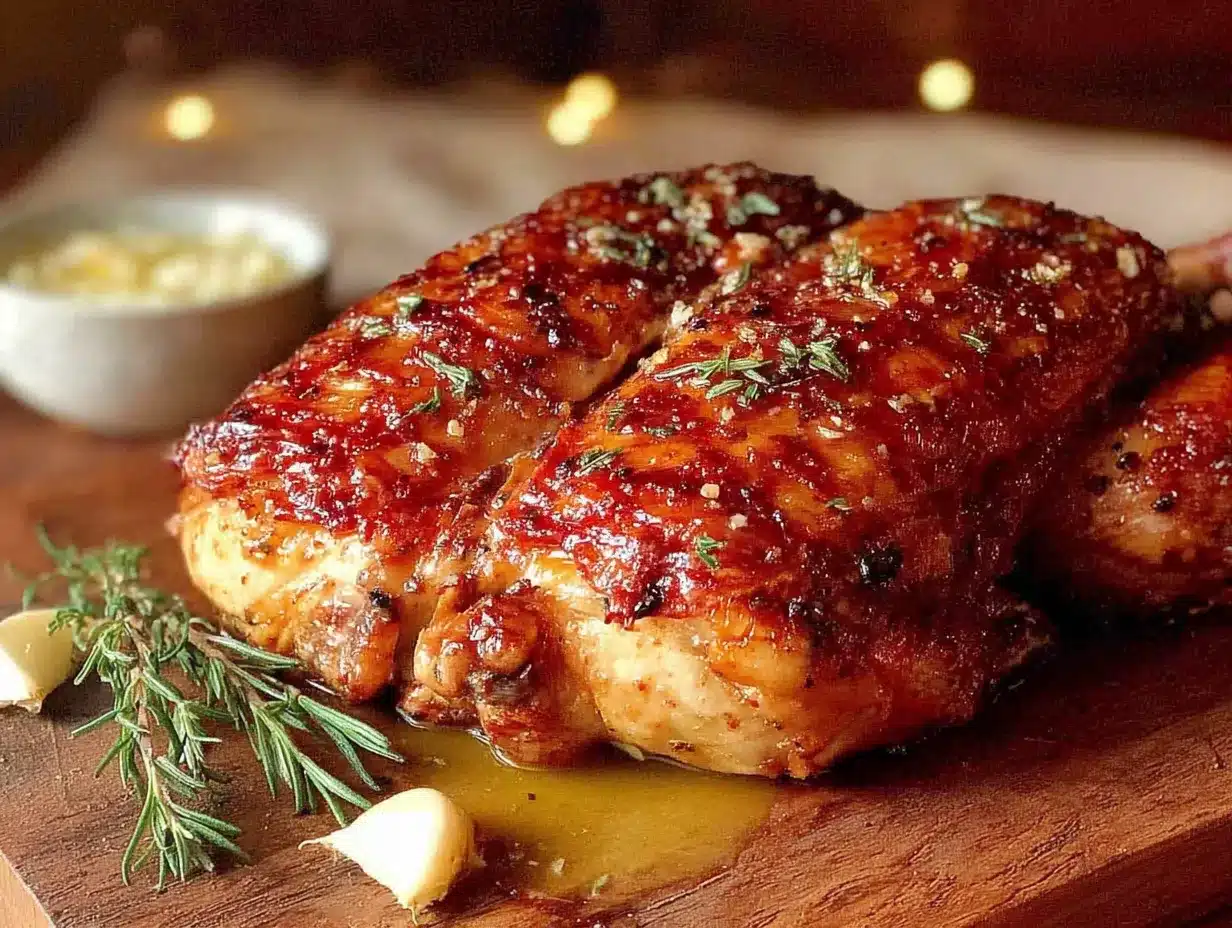
Let me tell you, I messed up the first one. I forgot to pat the bird dry, and the skin came out more soggy than crispy. My husband didn’t complain, but I knew. The second time, I got it right. That herb butter spatchcock turkey was the juiciest bird I’ve ever pulled out of an oven. The breast meat was tender, the legs were cooked through, and the skin? Crackly and golden. My kids, who usually pick at turkey, asked for seconds. Maybe you’ve been there—staring at a dry, overcooked bird that took hours and disappointed everyone. This method fixes all of that.
Why You’ll Love This Recipe
I’ve tested this herb butter spatchcock turkey at least six times now, and I keep coming back to it because it just works. Here’s why you’ll feel the same way:
- Faster Cooking Time – A spatchcocked turkey cooks in about half the time of a traditional roast. We’re talking 90 minutes instead of four hours. That’s a game-changer for a busy family dinner.
- Simple Ingredients – You probably already have butter, garlic, rosemary, and thyme in your kitchen. No need to hunt down exotic spices or specialty items.
- Perfect for Family Gatherings – This bird feeds a crowd without stress. It’s impressive enough for Thanksgiving but easy enough for a Sunday roast.
- Crowd-Pleaser – Even picky eaters love it. The herb butter keeps the meat moist and flavorful, so nobody reaches for the gravy just to choke it down.
- Unbelievably Delicious – The combination of crispy skin and juicy meat is next-level comfort food. It’s the kind of turkey that makes you close your eyes after the first bite.
What makes this recipe different from the rest is the technique. Spatchcocking—removing the backbone and flattening the bird—ensures even cooking. The breast and thighs finish at the same time, so you don’t end up with dry white meat and undercooked dark meat. Plus, the herb butter gets worked under the skin and all over the outside, creating a flavor crust that’s hard to beat. I learned this trick from a chef friend who swore by it, and now I swear by it too.
This isn’t just another turkey recipe. It’s the one that makes you look forward to leftovers. It’s the one your family will request year after year.
What Ingredients You Will Need
This recipe uses simple, wholesome ingredients to deliver bold flavor and satisfying texture without the fuss. Most of these are pantry staples, and the ones that aren’t are easy to find at any grocery store.
- For the Turkey
- 1 whole turkey (12–14 pounds), thawed if frozen – Look for a bird that’s not pre-brined if you can. I prefer Butterball or a local farm bird for the best texture.
- 2 tablespoons kosher salt – Use Diamond Crystal if you have it; it’s less salty by volume than Morton’s.
- 1 teaspoon black pepper, freshly ground
- 1 tablespoon baking powder – This is my secret for extra crispy skin. It helps dry out the surface. (Don’t skip it!)
- For the Herb Butter
- 1 cup (2 sticks) unsalted butter, softened – Let it sit out for an hour. Cold butter won’t spread under the skin.
- 4 cloves garlic, minced – Fresh garlic is better than jarred here. It makes a difference in flavor.
- 2 tablespoons fresh rosemary, finely chopped – Dried rosemary works in a pinch, but fresh is much more aromatic.
- 2 tablespoons fresh thyme leaves – You can substitute 2 teaspoons dried thyme if needed.
- 1 tablespoon fresh sage, chopped – Optional, but I love the earthy note it adds.
- 1 teaspoon lemon zest – Brightens up the butter and cuts through the richness.
- 1/2 teaspoon red pepper flakes – Just a pinch for a tiny kick. Leave it out if you’re feeding kids who are sensitive to heat.
- For the Roasting Pan
- 1 large onion, quartered – Adds flavor to the drippings for gravy.
- 2 carrots, roughly chopped
- 2 celery stalks, roughly chopped
- 1 cup low-sodium chicken broth – Use turkey broth if you have it. This goes in the pan to prevent burning.
Ingredient Notes & Substitutions: If you’re dairy-free, use vegan butter for the herb butter—just make sure it’s unsalted. For a gluten-free option, this recipe is naturally gluten-free as written. If you can’t find fresh herbs, dried herbs work but use half the amount. I’ve made this with a 10-pound bird and a 16-pound bird, and the timing adjusts by about 10 minutes per pound. Just use a meat thermometer to be safe.
Equipment Needed
You don’t need a lot of fancy tools for this recipe, but a few things make the job easier:
- Sharp kitchen shears – These are essential for cutting out the backbone. I use a pair of OXO shears that have held up for years. If you don’t have shears, ask your butcher to spatchcock the turkey for you—most will do it for free.
- Large cutting board – You need space to work. A plastic or wood board is fine, but make sure it’s stable.
- Roasting pan with a rack – The rack lifts the turkey so air circulates underneath, helping the skin crisp. If you don’t have a rack, crumple aluminum foil into coils and place them under the bird.
- Meat thermometer – This is non-negotiable. A digital instant-read thermometer is best. I’ve used a ThermoPro for years, and it’s never let me down.
- Mixing bowl – For the herb butter.
- Small saucepan – For making gravy from the drippings (optional but recommended).
Budget-Friendly Tip: If you don’t have kitchen shears, a sharp chef’s knife can work for cutting the backbone, but it takes more effort. You can also ask the meat counter at your grocery store to do it. Most will say yes.
Preparation Method
Let’s get to the good part. This method takes some work upfront, but it’s worth every minute. Plan for about 20 minutes of prep time before the turkey goes in the oven.
- Thaw and Dry the Turkey – If your turkey is frozen, thaw it in the refrigerator for 24 hours per 5 pounds. Once thawed, remove the giblets and neck from the cavity. Pat the turkey completely dry with paper towels—inside and out. This is the most important step for crispy skin. Let it sit uncovered in the fridge for an hour if you have time. (I’ve skipped this before, and the skin was sad. Don’t be like me.)
- Spatchcock the Bird – Place the turkey breast-side down on your cutting board. Using sharp kitchen shears, cut along one side of the backbone, from the tail to the neck. Repeat on the other side. Remove the backbone and save it for stock or gravy. Flip the turkey over and press down firmly on the breastbone with the heels of your hands until you hear a crack. The bird should lie flat. If it doesn’t, press harder. You won’t break anything important.
- Make the Herb Butter – In a mixing bowl, combine the softened butter, minced garlic, rosemary, thyme, sage (if using), lemon zest, and red pepper flakes. Mash it together with a fork until everything is evenly distributed. Set aside at room temperature.
- Season the Turkey – Mix the kosher salt, black pepper, and baking powder in a small bowl. Sprinkle this mixture all over the turkey, including the underside. Rub it in gently. Then, using your fingers, gently loosen the skin over the breast and thighs. Be careful not to tear it—just slide your fingers between the skin and the meat. Take about half the herb butter and push it under the skin, spreading it evenly over the breast and thigh meat. Rub the remaining herb butter all over the outside of the turkey.
- Prepare the Roasting Pan – Preheat your oven to 450°F. Place the quartered onion, carrots, and celery in the bottom of your roasting pan. Pour in the chicken broth. Place the turkey flat on the rack over the vegetables, breast-side up. Tuck the wing tips under the bird to prevent burning.
- Roast the Turkey – Put the pan in the oven and roast for about 80–90 minutes for a 12-pound bird. Start checking the temperature at the 60-minute mark. The turkey is done when the thickest part of the breast registers 155°F and the thighs register 165°F. The temperature will rise about 5 degrees as it rests. If the skin is browning too quickly, tent the bird loosely with foil.
- Rest and Carve – Remove the turkey from the oven and let it rest on the cutting board for 20–30 minutes. This allows the juices to redistribute. Don’t skip this step—I’ve carved too early and watched all the juice run out onto the board. While it rests, make gravy from the drippings if you want. Carve the turkey by removing the legs and thighs first, then slicing the breast meat against the grain.
Cooking Tips & Techniques
I’ve made enough mistakes with turkey to fill a cookbook. Here are the things I wish someone had told me:
- Don’t skip the drying step. Wet skin equals soggy skin. Patting the turkey dry and letting it air-dry in the fridge for an hour makes a huge difference. I once rushed this step and ended up with skin that peeled off like wet paper. Not my finest moment.
- Use a meat thermometer, not the pop-up timer. Those plastic pop-up things that come with the turkey are notoriously unreliable. I trust my instant-read thermometer way more. Insert it into the thickest part of the breast and the inner thigh, avoiding the bone.
- Let the butter come to room temperature. Cold butter won’t spread under the skin. You’ll end up tearing the skin trying to force it. Leave the butter out for at least an hour before you start.
- Multitask wisely. While the turkey roasts, you can make side dishes like mashed potatoes or green bean casserole. The turkey doesn’t need babysitting—just set a timer and check the temperature periodically.
- Save the backbone. Don’t throw it away! Toss it in a pot with some water, onion, and carrot scraps, and simmer for an hour. You’ll have homemade turkey stock for soup or gravy.
Common Mistake to Avoid: Overcrowding the pan with vegetables. The veggies should be in a single layer under the rack. If they’re piled up, they’ll steam instead of roast, and the drippings won’t caramelize properly.
Variations & Adaptations
This recipe is flexible, and I’ve tried a few different versions over the years. Here are some of my favorites:
- Citrus Herb Butter – Add the zest of one orange and one lemon to the herb butter, and stuff the turkey cavity with halved citrus fruits before roasting. The citrus adds a bright, fresh flavor that pairs beautifully with the herbs.
- Spicy Chipotle Version – Mix 2 tablespoons of adobo sauce from canned chipotles into the herb butter. It adds a smoky heat that’s amazing if you like a little kick. My husband loves this version, but the kids prefer the original.
- Garlic and Herb Dry Brine – Instead of making herb butter, mix the salt, pepper, baking powder, and dried herbs together and rub it all over the turkey. Let it sit uncovered in the fridge for 24 hours. The skin gets incredibly crispy, and the meat is well-seasoned throughout.
- Dairy-Free Adaptation – Use vegan butter or olive oil instead of regular butter. The texture won’t be quite as rich, but it still works. I’ve done this for a friend with a dairy allergy, and nobody noticed the difference.
- Smoked Spatchcock Turkey – If you have a smoker, this recipe translates beautifully. Smoke the spatchcocked turkey at 275°F for 3–4 hours, or until it reaches 165°F in the thighs. The herb butter keeps it moist, and the smoke adds another layer of flavor.
Personal Variation: Last Christmas, I added a tablespoon of maple syrup to the herb butter for a sweet-savory twist. The skin caramelized beautifully, and the kids devoured it. I’m not sure I’ll go back to the plain version after that.
Serving & Storage Suggestions
This turkey is best served hot, right after it’s rested. The skin is at its crispiest, and the meat is at its juiciest. Here’s how to make the most of it:
Serving Temperature & Presentation: Carve the turkey and arrange the slices on a large platter. Garnish with fresh rosemary sprigs and lemon wedges for a beautiful presentation. If you’re serving a crowd, keep the carved meat covered with foil to stay warm.
Complementary Dishes: This turkey pairs perfectly with classic sides like mashed potatoes, roasted Brussels sprouts, cranberry sauce, and dinner rolls. The herb flavors in the turkey also go well with a simple green salad or roasted root vegetables.
Storage Instructions: Store leftover turkey in an airtight container in the refrigerator for up to 4 days. For longer storage, wrap the meat tightly in plastic wrap and aluminum foil, then freeze for up to 3 months. Thaw in the refrigerator overnight before reheating.
Reheating Methods: The best way to reheat turkey is in a low oven. Place the slices in a baking dish with a splash of chicken broth, cover with foil, and warm at 300°F for 10–15 minutes. You can also reheat in the microwave, but the texture won’t be as good. For crispy skin, reheat in a hot skillet with a little butter for 2–3 minutes per side.
Flavor Development: Honestly, leftover turkey often tastes better the next day. The flavors meld together, and the meat becomes even more tender. I love using leftovers for turkey sandwiches, turkey soup, or turkey pot pie.
Nutritional Information & Benefits
This herb butter spatchcock turkey is a great source of lean protein and healthy fats. Here’s an approximate nutritional breakdown per 4-ounce serving (without skin):
- Calories: 250
- Protein: 32g
- Fat: 12g (from butter and turkey fat)
- Carbohydrates: 1g
- Fiber: 0g
- Sodium: 450mg (varies with salt amount)
Health Benefits: Turkey is rich in B vitamins, selenium, and phosphorus, which support energy metabolism and bone health. The herbs in the butter—rosemary, thyme, and sage—are packed with antioxidants and anti-inflammatory compounds. Garlic adds immune-boosting properties. This recipe is naturally gluten-free and low-carb, making it suitable for many dietary needs.
Dietary Considerations: For a lower-sodium version, reduce the salt to 1 tablespoon. For a dairy-free option, use vegan butter. This recipe is not suitable for a strict low-fat diet due to the butter, but the fat adds flavor and helps keep the meat moist.
Personal Wellness Perspective: I love that this recipe allows me to serve a wholesome, protein-rich meal to my family without spending hours in the kitchen. It’s comfort food that I can feel good about.
Frequently Asked Questions
Can I spatchcock a frozen turkey?
No, you need to thaw the turkey completely before spatchcocking. A frozen bird is too rigid to cut and flatten. Thaw it in the refrigerator for 24 hours per 5 pounds.
How do I know when the turkey is done?
Use a meat thermometer. The breast should reach 155°F, and the thighs should reach 165°F. The temperature will rise about 5 degrees as it rests. Don’t rely on the pop-up timer that comes with the turkey.
Can I make the herb butter ahead of time?
Yes! You can make the herb butter up to 3 days in advance. Store it in the refrigerator, and let it come to room temperature for about 30 minutes before using it.
What do I do with the backbone?
Save it! The backbone is perfect for making turkey stock or gravy. Just simmer it with water, onion, carrots, and celery for an hour, then strain. You can also freeze it for later use.
How do I get extra crispy skin?
Pat the turkey completely dry before seasoning. Let it air-dry in the fridge for an hour if you have time. The baking powder in the seasoning also helps crisp the skin. Roasting at a high temperature (450°F) is key.
Conclusion
This herb butter spatchcock turkey is the recipe I turn to whenever I want a stress-free, impressive roast that feeds my family without drama. It’s faster than traditional roasting, juicier than any bird I’ve made before, and the herb butter adds a flavor that makes everyone ask for the recipe. Whether you’re cooking for Thanksgiving, Christmas, or just a Sunday dinner that feels special, this method delivers every time.
I love that this recipe lets me spend less time worrying about the turkey and more time enjoying the people around the table. It’s forgiving enough for beginners and impressive enough for experienced cooks. Honestly, once you try spatchcocking, you might never go back.
Now I’d love to hear from you! Have you tried spatchcocking a turkey before? What’s your favorite herb combination for the butter? Drop a comment below and let me know. And if you make this recipe, share a photo—I can’t wait to see your beautiful roast!
Pin This Recipe!
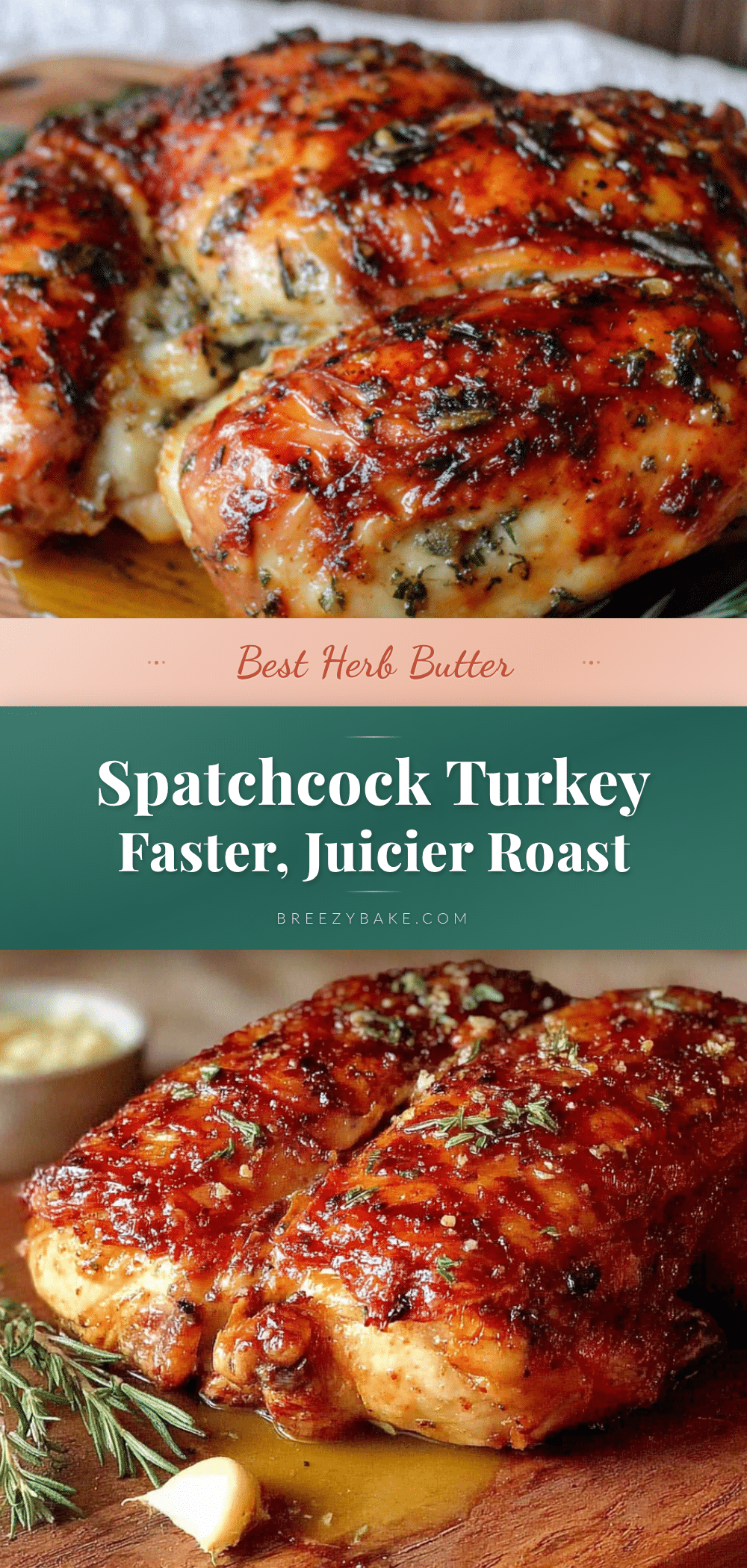
Best Herb Butter Spatchcock Turkey – Easy, Juicy Roast for Dinner
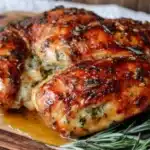
This herb butter spatchcock turkey is the juiciest bird you’ll ever pull out of an oven. With crispy skin, tender meat, and a faster cooking time, it’s perfect for family gatherings and holiday feasts.
- Prep Time: 20 minutes
- Cook Time: 90 minutes
- Total Time: 1 hour 50 minutes
- Yield: 12 servings 1x
- Category: Main Course
- Cuisine: American
Ingredients
- 1 whole turkey (12–14 pounds), thawed if frozen
- 2 tablespoons kosher salt
- 1 teaspoon black pepper, freshly ground
- 1 tablespoon baking powder
- 1 cup (2 sticks) unsalted butter, softened
- 4 cloves garlic, minced
- 2 tablespoons fresh rosemary, finely chopped
- 2 tablespoons fresh thyme leaves
- 1 tablespoon fresh sage, chopped (optional)
- 1 teaspoon lemon zest
- 1/2 teaspoon red pepper flakes
- 1 large onion, quartered
- 2 carrots, roughly chopped
- 2 celery stalks, roughly chopped
- 1 cup low-sodium chicken broth
Instructions
- Thaw and Dry the Turkey: If frozen, thaw in refrigerator for 24 hours per 5 pounds. Remove giblets and neck. Pat turkey completely dry with paper towels. Let sit uncovered in fridge for 1 hour if possible.
- Spatchcock the Bird: Place turkey breast-side down on cutting board. Using sharp kitchen shears, cut along one side of backbone from tail to neck. Repeat on other side. Remove backbone and save for stock. Flip turkey over and press down firmly on breastbone until it cracks and lies flat.
- Make the Herb Butter: In a mixing bowl, combine softened butter, minced garlic, rosemary, thyme, sage (if using), lemon zest, and red pepper flakes. Mash together with a fork until evenly distributed. Set aside at room temperature.
- Season the Turkey: Mix kosher salt, black pepper, and baking powder in a small bowl. Sprinkle all over turkey, including underside. Gently loosen skin over breast and thighs. Push half the herb butter under the skin, spreading evenly. Rub remaining herb butter all over outside of turkey.
- Prepare the Roasting Pan: Preheat oven to 450°F. Place quartered onion, carrots, and celery in bottom of roasting pan. Pour in chicken broth. Place turkey flat on rack over vegetables, breast-side up. Tuck wing tips under bird.
- Roast the Turkey: Roast for 80–90 minutes for a 12-pound bird. Start checking temperature at 60-minute mark. Turkey is done when breast registers 155°F and thighs register 165°F. Tent with foil if browning too quickly.
- Rest and Carve: Remove from oven and let rest on cutting board for 20–30 minutes. Carve by removing legs and thighs first, then slicing breast meat against the grain.
Notes
Pat the turkey completely dry for crispy skin. Use a meat thermometer for accuracy. Let butter come to room temperature before using. Save the backbone for stock. If skin browns too quickly, tent with foil.
Nutrition
- Serving Size: 4 ounces
- Calories: 250
- Sodium: 450
- Fat: 12
- Saturated Fat: 7
- Carbohydrates: 1
- Protein: 32
Keywords: herb butter spatchcock turkey, spatchcock turkey, juicy turkey, roasted turkey, Thanksgiving turkey, easy turkey recipe